


July 2026
When discussing flavours, most people immediately associate them with confectionery, beverages, or processed foods. In reality, flavours also play an important role in the pharmaceutical industry, particularly in oral dosage forms such as syrups, oral solutions, chewable tablets, lozenges, and a wide range of healthcare and dietary supplement products.
In pharmaceutical formulations, flavours serve a purpose far beyond simply making medicines taste better. They help mask unpleasant odours and bitter active ingredients, enhance the overall sensory experience, and ultimately improve patient acceptance and treatment adherence—especially among children and older adults.

Flavours help mask undesirable tastes and odours in pharmaceutical products
Are flavours used in pharmaceutical products?
The answer is yes. However, it is important to understand their role and the scope of their application.
In pharmaceutical formulations, flavours are classified as excipients or formulation support ingredients rather than Active Pharmaceutical Ingredients (APIs). Their primary function is to improve the sensory characteristics of a product without contributing any direct therapeutic effect.
According to the U.S. Food and Drug Administration (FDA), excipients are inactive ingredients incorporated into pharmaceutical formulations to support manufacturing, storage, distribution, and product usability. Among these, flavouring agents are widely used in oral dosage forms to improve patient acceptability.
This demonstrates that the use of flavours in pharmaceutical products is not a new practice. Instead, flavour systems have become an integral part of modern oral formulation development, helping manufacturers create products that patients are more willing to take consistently.
What are flavours?
Flavours are carefully designed blends of flavouring substances developed to create, modify, or enhance the taste and aroma of a product.
For pharmaceutical applications, manufacturers typically use flavour systems specifically selected for non-food products. These flavour solutions are developed to meet the quality standards and regulatory requirements of each target market.
It is important to note, however, that not every flavour is suitable for pharmaceutical use. Selecting an appropriate flavour requires careful evaluation of multiple factors, including:
- The formulation composition
- Technical specifications of the flavour material
- Compatibility with other formulation ingredients
- Regulatory requirements in the intended market
For this reason, flavour selection should always be considered as part of the overall formulation development process rather than as an isolated ingredient choice.
>>> Read more: Flavours: Essential Facts You Should Know
Why should the pharmaceutical industry use flavours?
Many pharmaceutical active ingredients possess inherently unpleasant sensory characteristics. Antibiotics, for example, are often associated with intense bitterness and lingering aftertaste, while certain vitamins and minerals may exhibit metallic notes or astringency.
If these undesirable sensory attributes are not properly managed, they can significantly reduce the patient experience—particularly for children and older adults, who tend to be more sensitive to unpleasant tastes and odours.
To address these challenges, pharmaceutical formulators commonly combine multiple taste-masking strategies, including:
- Sweeteners
- Acidity regulators
- Microencapsulation technologies
- Flavour systems
Among these approaches, flavours play a particularly important role because they help create a sensory profile that matches consumer preferences while masking or reducing the perception of undesirable tastes and odours associated with active pharmaceutical ingredients.
Rather than simply adding flavour, a well-designed flavour system contributes to a more balanced sensory experience, supporting better patient acceptance without affecting the therapeutic performance of the medicine.
>>> Read more: The role of flavouring agents in pharmaceuticals
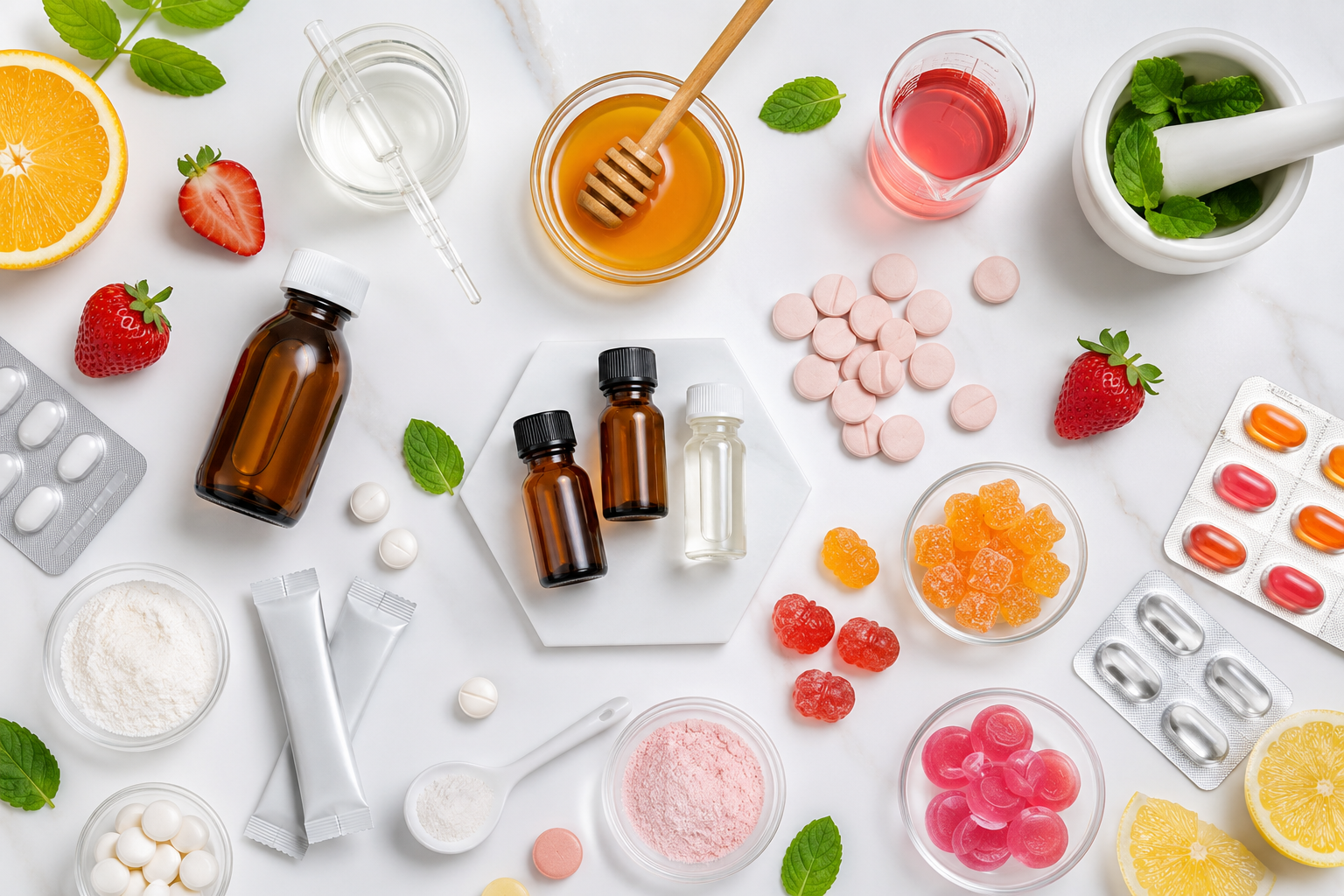
Enhancing the sensory experience of pharmaceutical products with flavours
Applications of flavours across different pharmaceutical dosage forms
Not all pharmaceutical dosage forms present the same sensory challenges. Each formulation has its own composition, manufacturing process, administration method, and patient experience, making flavour selection a formulation-specific process rather than a one-size-fits-all solution.
During product development, formulators must consider far more than simply choosing a pleasant flavour. Key questions include:
- Is the flavour compatible with the active pharmaceutical ingredient (API)?
- Will the flavour remain stable throughout manufacturing and the product’s shelf life?
- How long will the aftertaste persist after administration?
- How will patients perceive the flavour at different stages of consumption?
For this reason, even the same orange or strawberry flavour may require completely different flavour profiles depending on whether it is intended for a syrup, a chewable tablet, or a gummy supplement. Each dosage form demands a flavour system specifically designed to deliver the desired sensory performance.
Syrups and oral liquid formulations
Among oral dosage forms, syrups and oral liquid medicines are the most common applications for pharmaceutical flavours.
Patients are exposed to both the aroma and taste immediately upon opening the bottle and throughout the entire administration process. Because the liquid remains in the mouth for a relatively longer period, unpleasant bitterness or characteristic odours from active ingredients can become much more noticeable.
As a result, flavour systems for syrups typically need to achieve several objectives simultaneously:
- Effectively mask the taste and odour of active ingredients.
- Work harmoniously with sweeteners and acidity regulators.
- Deliver a pleasant aftertaste that remains comfortable after swallowing.
- Maintain stability in high-moisture formulations and across the product’s specified pH range.
A well-designed flavour system therefore contributes not only to taste masking but also to a more enjoyable overall patient experience.
Chewable tablets and lozenges
Compared with syrups, chewable tablets and lozenges remain in the oral cavity for much longer, allowing patients to perceive the flavour throughout the entire consumption process. This extended exposure places significantly higher demands on flavour performance.
If the flavour profile is too mild, the bitterness of the active ingredient may quickly become apparent during chewing or dissolution. Conversely, an overly intense flavour can create a harsh, unbalanced sensory experience and leave an unpleasant lingering impression.
Beyond bitterness masking, pharmaceutical formulators also evaluate several additional sensory attributes, including:
- Aftertaste performance.
- Cooling or soothing mouthfeel.
- Flavour longevity throughout product use.
- Compatibility with sweeteners, tableting excipients, and taste-modifying ingredients.
For throat lozenges and respiratory care products, flavour profiles such as mint, lemon, honey, and selected herbal notes are frequently used to provide a refreshing and soothing sensation.
However, flavour selection should always align with the product’s intended function, target consumers, and brand positioning rather than simply following current market trends.
Powder formulations
In recent years, powdered oral products—including vitamin blends, mineral supplements, collagen formulations, and electrolyte drinks—have experienced significant market growth.
Unlike many other dosage forms, flavour systems for powdered products must perform effectively at two distinct stages of the consumer experience.
- Stage one – Upon opening the package: The aroma released when the package is first opened creates the consumer’s initial sensory impression and plays an important role in shaping overall product perception.
- Stage two – After reconstitution: Once dissolved in water, the flavour must integrate seamlessly with the taste profile of the active ingredients and other formulation components, delivering a balanced and pleasant drinking experience.
Beyond flavour creation, formulation scientists also evaluate several critical technical parameters, including:
- Solubility of the flavour system
- Stability after reconstitution
- Flavour retention throughout consumption
- The impact of water temperature on sensory performance
These factors ultimately determine whether the actual consumer experience matches the intended product design.
Gummies and nutraceutical products
The rapid growth of gummies has transformed the way sensory experiences are designed for health and wellness products. Unlike conventional medicines, gummies are generally expected to deliver an experience that closely resembles that of a food product. Consequently, flavour systems must meet higher standards in terms of naturalness, authenticity, and the balance between aroma, taste, and texture.
In addition to masking the undesirable notes of collagen, vitamins, or minerals, flavours also contribute to strengthening brand identity and enhancing the product’s perceived value.
Current market trends indicate that many manufacturers are increasingly adopting:
- Natural fruit flavour profiles
- Tropical fruit flavours
- Blended flavour profiles
These flavour concepts help differentiate products while meeting consumers’ growing expectations for enjoyable and premium sensory experiences.
Viet Huong provides flavour solutions for pharmaceutical product
Selecting a flavour for pharmaceutical applications is far more complex than choosing from a catalogue of standard samples. Every formulation presents unique challenges, including differences in active ingredients, dosage forms, target consumers, and desired sensory outcomes. As a result, flavour selection should be integrated into the formulation development process from the very beginning.
Supporting formulation development from the early research stage
Rather than recommending flavours solely based on initial sensory preferences, Viet Huong works closely with customers from the earliest stages of formulation development.
This collaborative approach enables flavour selection to reflect the product’s actual formulation, manufacturing conditions, and intended user experience.
Through continuous evaluation and refinement, manufacturers can:
- Shorten formulation development timelines
- Reduce unnecessary formulation trials
- Improve development efficiency
- Increase the likelihood of achieving the desired sensory profile in the final product
Customized flavour development for every product
With more than 30 years of experience in the flavour industry and extensive knowledge of market requirements, Viet Huong is committed to delivering flavour solutions tailored to each customer’s specific needs.
Beyond supplying flavour ingredients, we develop customised flavour profiles designed to match the sensory objectives and technical requirements of individual pharmaceutical products.
As pharmaceutical companies continue to differentiate their products through patient experience, a carefully designed flavour profile can do far more than improve taste. It can reinforce product identity, enhance brand value, and create a more memorable user experience.
A comprehensive flavour portfolio for oral dosage forms
Backed by an experienced technical team, Viet Huong provides flavour solutions for a wide variety of oral pharmaceutical and healthcare products, including:
- Syrups and oral liquid medicines
- Chewable tablets
- Lozenges
- Powdered drink formulations
- Gummies
- Dietary supplements and nutritional products
Throughout every stage of product development, Viet Huong is committed to working alongside customers—from early formulation research to final product commercialization—to help create pharmaceutical products that deliver both technical performance and an improved patient experience.

Viet Huong is always ready to partner with customers throughout the product development process.
FAQ
Do flavours affect the therapeutic efficacy of pharmaceutical products?
No.
Flavours are incorporated into pharmaceutical formulations solely to improve the product’s sensory profile. They do not contribute to the therapeutic effect of the medicine or alter the efficacy of the active pharmaceutical ingredients (APIs).
Which pharmaceutical dosage forms commonly use flavours?
Flavours are widely used in a variety of oral pharmaceutical and healthcare products, including:
- Syrups and oral liquid formulations
- Chewable tablets
- Lozenges
- Powdered drink formulations
- Gummies
- Dietary supplements
- Vitamin and mineral supplements
Each dosage form has its own technical requirements in terms of flavour profile, formulation compatibility, stability, and overall sensory performance. Consequently, flavour systems should be developed specifically for the intended application rather than applied universally across different product formats.
Why are fruit flavours commonly used in paediatric medicines?
Children are generally more sensitive than adults to the bitter taste and unpleasant odours of many active pharmaceutical ingredients.
For this reason, formulation developers often select familiar fruit flavour profiles to improve the palatability and overall acceptance of paediatric medicines.
However, flavour selection should not rely solely on market trends. The most appropriate flavour profile should be determined through consumer research, sensory evaluation, and formulation testing to ensure it meets both patient preferences and product objectives.
If you are developing flavour solutions for pharmaceutical or healthcare products, Viet Huong is ready to support your project at every stage of product development. From formulation trials and flavour optimisation to final product refinement, our technical team works closely with customers to develop flavour systems that enhance sensory performance while meeting the specific requirements of each formulation.
Whether your product is a syrup, chewable tablet, lozenge, gummy, or powdered supplement, we are committed to helping you create pharmaceutical products that deliver a better patient experience without compromising formulation performance.