


July 2026
During product development, the question is not “Should we use natural flavours or artificial flavours?” but rather “Which flavour solution best supports our product development objectives?” Choosing the right flavour is a strategic decision that influences not only the product’s sensory performance but also manufacturing efficiency, regulatory compliance, brand positioning and ultimately commercial success.
In this article, Viet Huong explores the key differences between natural and artificial flavours, as well as practical criteria to select the most appropriate flavour solution for their applications.

Natural flavours vs. artificial flavours: Which one should you choose?
Flavours are more than just aroma
Flavours do far more than simply add aroma to a product. They help define product identity, customer sensory perception, and significantly influence market acceptance. For food manufacturers, flavour selection should be considered a strategic component of product information rather than a finishing touch added at the end of development.
The right flavour can help manufacturers:
- Enhance overall flavour intensity without necessarily increasing salt or seasoning levels.
- Highlight the characteristic taste of key ingredients such as meat, seafood, vegetables, or fruits.
- Improve the perception of freshness, creaminess, richness, or lingering aftertaste.
- Maintain consistent sensory quality across production batches.
- Create a distinctive and recognizable product identity.
This is precisely why many food manufacturers no longer regard flavour as the “final ingredient” added after product formulation is complete. Instead, flavour development is integrated into the product design process from the earliest stages of R&D.

Flavours are not only responsible for creating appealing aromas but also play an essential role in enhancing flavour fullness, mouthfeel, and overall sensory satisfaction.
>>> Read more: Flavours: Essential Facts You Should Know
Natural flavours vs. artificial flavours: What is the difference?
Flavours are generally classified according to the origin of their flavouring components as well as the labelling regulations of each target market. Among the various categories, the two most widely recognized are natural flavours and artificial flavours.
#1: Origin of the flavouring components
Natural flavours are produced from ingredients of natural origin, including fruits, vegetables, herbs, spices, meat, seafood, and other plant or animal sources.
These flavouring substances are typically obtained through physical processes such as:
- Steam distillation
- Cold pressing
- Solvent extraction
Because they originate from natural raw materials, natural flavours are widely recognized for delivering authentic flavour profiles while supporting consumer demand for products perceived as more natural.
In contrast, artificial flavours consist of chemically synthesized compounds produced through controlled laboratory processes. These compounds are specifically designed to replicate existing flavours found in nature or to create entirely new flavour profiles without requiring direct extraction from natural raw materials.
Another important category is Nature-Identical Flavours. Nature-identical flavouring substances possess the same chemical structure as compounds naturally occurring in food. The difference lies in their production method—they are synthesized rather than extracted from natural sources.

Differences in flavouring components: natural flavours vs. artificial flavours
#2: Product application performance
During product development, the most important consideration is not how a flavour is produced, but how it performs within the final product formulation.
For example:
- Bakery applications require flavours capable of maintaining their sensory profile after high-temperature processing.
- Dairy products often require flavour systems that comply with specific market regulations while supporting brand positioning and labelling requirements.
This illustrates that the decision between natural and artificial flavours should never be based solely on the origin of the ingredients. Instead, it should reflect the functional requirements of the intended application.
#3: Labelling strategy and brand positioning
For brands pursuing a Clean Label strategy, selecting flavour solutions that align with this positioning is essential. Likewise, products intended for export must comply with flavour regulations and labelling requirements in their destination markets. In other words, flavour selection is increasingly influenced by branding objectives, regulatory expectations, and product positioning—not simply by whether a flavour is natural or artificial.
#4: Production stability
A common misconception is that artificial flavours are inherently more stable than natural flavours—or vice versa.
In reality, flavour stability depends on multiple technical factors, including:
- Flavour profile formulation
- Flavour production technology
- Processing conditions
- Final product matrix
- Manufacturing environment
Therefore, the real question is not “Which type of flavour should we choose?” but rather “Which flavour performs best in this specific application?”
Criteria for selecting a suitable flavour
Flavour selection directly affects product quality, production cost, manufacturing efficiency, and commercial viability. For this reason, R&D teams typically evaluate flavour solutions based on the following criteria.
Sensory performance
- Authenticity: The flavour should accurately reproduce the desired taste profile—whether fresh, rich, savoury, creamy, fruity, or roasted.
- Flavour intensity and persistence: The flavour should provide sufficient impact and maintain its sensory characteristics throughout consumption.
- Balance: A well-designed flavour complements the base formulation without overpowering other ingredients.
Stable
- Heat stability: For thermally processed foods, flavours should retain their sensory characteristics during baking, extrusion, pasteurization, sterilization, or other heat treatments.
- Formula compatibility: Flavours should remain chemically compatible with other ingredients without causing colour changes, phase separation, off-notes, or reduced product quality.
Cost efficiency
- Effective dosage that delivers the desired flavour while minimizing usage levels.
- Reliable supply capacity capable of supporting large-scale production.
- Availability in suitable formats, including liquid or powder, compatible with existing manufacturing equipment.
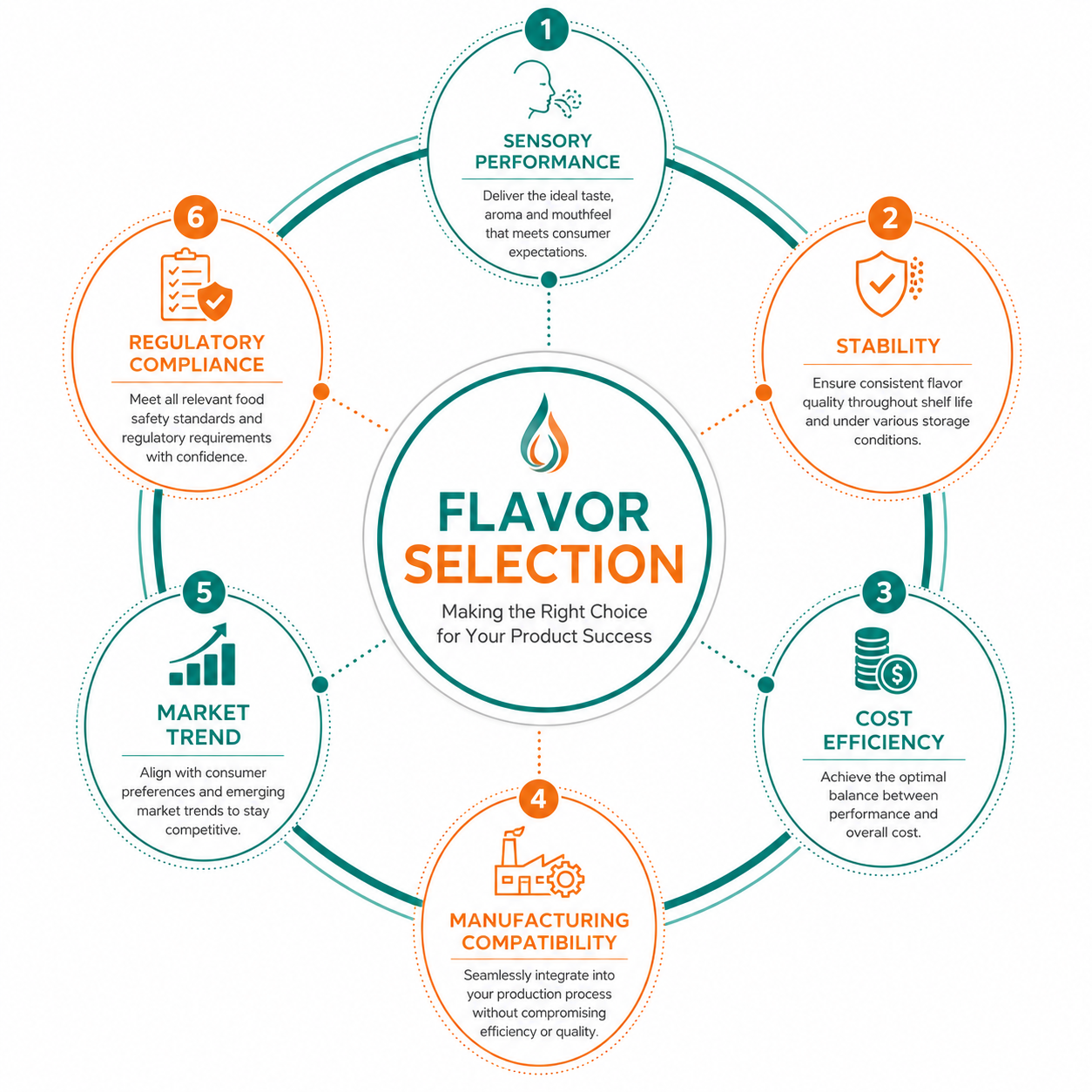
Criteria for selecting the right flavour
Market trends and application-specific requirements
- Consumer trends: Flavour development should be guided by current consumer preferences and market insights to maximize commercial success.
- Industry-specific requirements: Different industries, product categories, and export markets often require flavour solutions that satisfy unique technical, regulatory, or application-specific standards.
- Origin and regulatory compliance: Selected flavour ingredients should comply with applicable food safety regulations and certification requirements, such as FSSC 22000, while ensuring that all ingredients are legally permitted and used within established safety limits.
When should natural flavours be prioritized?
According to Mordor Intelligence, global consumer preferences have increasingly shifted toward products featuring simpler ingredient lists with greater transparency. Today’s consumers are concerned not only with great taste but also with ingredient origin, product composition, and the information presented on food labels. For brands positioned within the premium, organic, or better-for-you segments, natural flavours can help reinforce brand value while creating a distinctive market identity.
This is particularly important for products where consumers expect authentic natural taste, such as:
- Fruit beverages
- Tea
- Dairy products
- Organic foods
Similarly, products developed under a Clean Label strategy or intended for export to markets with stringent ingredient requirements may benefit from prioritizing natural flavour solutions.

Prioritizing natural flavours for clean label product development
However, in practice, many successful products are not defined simply by the use of natural flavours. Their success results from a comprehensive R&D process involving flavour design, sensory evaluation, formulation optimization, and manufacturing expertise.
Ultimately, the key to successful flavour selection lies not in whether a flavour is natural or artificial, but in how effectively it meets the technical requirements of the application and the expectations of the target market.
Choosing the right flavour at the earliest stage of product development can significantly shorten development timelines while improving product quality, production consistency, and long-term commercial competitiveness.